On This Page
Table of Contents
Gold has captivated human civilizations for over 6,000 years, admired not only for its beauty but also for its rarity, stability, and enduring economic value. Yet despite its global importance, the geology of gold remains a mystery to many. How does gold form? Where does it accumulate? Why are some regions rich in gold while others have almost none? These questions fall under the domain of mining geology, a specialized branch that blends Earth science with economic mineral discovery.
Understanding Gold Properties, Sources, and Geological Context
What Makes Gold Unique?
Gold (chemical symbol Au) is a noble metal with exceptional properties:
- Non-reactive: Gold does not rust, corrode, or tarnish.
- Highly malleable: A single ounce can be beaten into a sheet nearly 100 square feet.
- Excellent conductor: Its reliability in electronics makes it indispensable.
- Biocompatible: Used in dentistry, aerospace, and medical devices.
- Aesthetic and symbolic value: Jewelry and currency have had value since ancient times.
These characteristics explain why gold is valuable, but its rarity is tied directly to the geology of gold—a result of very specific geological events.
Where Does Gold Occur Geologically?
Gold rarely occurs in isolation. Instead, it forms within host rocks through geological processes that extend over millions of years. In mining geology, the following environments are the primary sources of gold:
1. Hydrothermal Veins
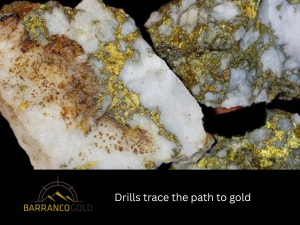
These are narrow fractures filled with quartz and gold, formed when fluid-rich solutions deposit minerals within cracks in the crust.
2. Greenstone Belts
Ancient volcanic-sedimentary terrains where some of the world’s largest gold deposits exist (Australia, Canada, Africa).
3. Placer Deposits
Free gold particles that accumulate in rivers, streams, beaches, and alluvial plains due to gravity and water flow.
4. Porphyry Systems
Large, low-grade deposits that can contain gold alongside copper and molybdenum.
5. Orogenic Belts
Formed during mountain building, where tectonic forces create deep crustal fluid pathways.
6. Sedimentary-Hosted Deposits
Gold is locked within chemical sediments, black shales, and conglomerates.
Understanding these geological environments is fundamental to mining geology and mineral exploration. They guide geologists toward areas most likely to contain valuable ore bodies.
How Gold Forms The Geologic Processes Behind Gold Deposits
One of the central questions in both Earth science and mining economics is:
How is gold formed geologically?
The answer involves a combination of tectonics, heat, pressure, and fluid movement over deep geological time. Modern research in geology and mining identifies four main pathways:
1. Hydrothermal Gold Formation (Most Common Process)
This is the primary explanation for how gold is formed geologically in vein and lode deposits.
- Deep beneath Earth’s surface, hot fluids circulate through fractures.
- These fluids leach minerals, including gold, from rocks.
- As they cool or mix with other fluids, gold precipitates.
- Quartz veins often serve as pathways and hosts for gold.
Hydrothermal deposits can form during volcanic activity, mountain-building, or crustal deformation events.
2. Magmatic Gold Formation
In rare cases:
- Gold forms directly from magma as it cools.
- Trace amounts of gold can crystallize with minerals such as pyrite, chalcopyrite, or magnetite.
- Porphyry gold systems are associated with this process.
This magmatic origin is especially important in regions with high volcanic activity.
3. Metamorphic Gold Processes
During the formation of mountains:
- Rocks are buried and subjected to extreme pressure and heat.
- Fluids mobilize gold and other minerals.
- Gold is re-deposited in structurally controlled veins.
These orogenic gold deposits represent some of the world’s richest mines.
4. Weathering and Placer Gold Formation
Once exposed at the surface:
- Gold is released from its host rock by erosion.
- It travels through rivers and streams due to its high density.
- Gold settles where water slows, forming placer deposits.
This explains why certain riverbeds and alluvial plains contain nuggets and fine gold.
Together, these processes explain how gold is formed geologically and why its distribution varies across different continents.
Geological Exploration Locating Gold Deposits
Finding gold isn’t guesswork; it’s a systematic, science-backed process within geological mining, involving multiple data-driven steps.
1. Geological Mapping
Geologists study:
- Rock types
- Structural features
- Faults and folds
- Mineral indicators
- Surface alterations
Mapping creates the foundation for targeted exploration, revealing patterns linked to gold mineralization.
2. Geochemical Sampling
Sampling helps detect microscopic traces of gold or related elements.
Common techniques:
- Soil sampling near fault zones
- Stream sediment sampling for placer exploration
- Rock chip sampling from outcrops
- Pathfinder element analysis (arsenic, antimony, bismuth, mercury)
Geochemical anomalies guide drilling decisions.
3. Geophysical Surveys
Remote-sensing tools identify subsurface structures where gold may exist:
- Magnetic surveys reveal buried faults and volcanic rocks.
- Induced polarization (IP) detects metal-rich zones.
- Gravity surveys detect density variations.
- Resistivity surveys locate altered zones or quartz veins.
These non-invasive methods are crucial early steps in mining and geology exploration programs.
4. Drilling and Core Analysis
Once promising targets are found:
- Geologists drill vertical or angled holes.
- Core samples are extracted and analyzed.
- Assays determine gold grade (g/ton).
- Geological logging documents rock types, alteration, and mineral content.
Drilling is the most definitive tool for estimating the size and economic potential of a gold deposit.
Mining Gold From Exploration to Extraction
After confirming a viable deposit, engineers and geologists determine the safest and most efficient way to extract gold. The mining method depends on depth, ore geometry, host rock type, and grade.
1. Open-Pit Mining
Used when:
- Deposits are near the surface
- Ore bodies are wide and low-grade
- Large-scale equipment is economically viable
Open pits are gradually deepened using benches.
2. Underground Mining
Used for:
- Deep deposits
- Narrow, high-grade veins
- Structurally complex ore bodies
Underground Mining methods include cut-and-fill, longhole stoping, shrinkage mining, and room-and-pillar, each chosen based on the depth, geometry, and stability of the gold-bearing rock.
3. Placer Mining
Ideal for alluvial gold:
- Sluice boxes
- Dredging systems
- Trommels
- Gravity-based separation
This is the oldest mining method used historically in California, Alaska, and India’s river systems.
Gold Processing and Extraction Techniques
After mining, gold extraction involves several sophisticated steps:
Gravity Concentration: Uses density differences to separate heavy gold from lighter materials common in placer mining.
Flotation: Gold-bearing sulfides are separated from gangue minerals.
Cyanide Leaching: Gold dissolves in a cyanide solution, forming a gold-cyanide complex.
Carbon-in-Pulp (CIP) and Carbon-in-Leach (CIL): Activated carbon absorbs gold from cyanide slurry.
Refining and Smelting: Final steps that produce 99.99% pure gold bars.
In modern mining geology, environmental management, reclamation, and ethical extraction practices are essential.
Why Understanding Gold Geology Matters
Understanding the geology of gold is essential for:
1. Investors
It helps evaluate project viability, risk, geological potential, and long-term profitability.
2. Students and Researchers
Gold acts as a natural tracer for Earth’s crustal processes.
3. Mining Professionals
Better geological understanding leads to improved resource estimation and safer mining methods.
4. Environmental Planners
Informed decisions reduce mining impact and enhance sustainability.
Knowledge of how gold is formed geologically, where it accumulates, and how it is extracted provides strategic insights into global gold supply and future exploration opportunities.
FAQ
1. How is gold formed geologically?
Gold typically originates from hydrothermal fluids circulating through the Earth’s crust. As these fluids cool or react with surrounding rocks, gold precipitates. It may also form through magmatic, metamorphic, or placer processes.
2. Where is gold most commonly found?
Gold is mainly found in hydrothermal veins, greenstone belts, placer deposits, porphyry systems, and orogenic belts.
3. What is mining geology?
Mining geology is the applied science that studies ore deposits, rock formations, structural geology, and extraction techniques used to locate and mine valuable minerals.
4. What is the difference between geology and mining?
Geology focuses on understanding Earth’s materials and processes, whereas mining involves extracting minerals. Together, they form the foundation of geological mining.
5. How do geologists find gold?
Geologists use mapping, geochemical sampling, geophysical surveys, and drilling to locate and analyze gold deposits.
Conclusion
The geology of gold reveals a remarkable story written deep within the Earth—one shaped by tectonic forces, hydrothermal activity, and the slow but powerful processes that concentrate this precious metal over millions of years. By understanding the relationship between mining and geology, we gain clearer insight into how gold is formed, where it occurs, and why certain regions become major gold-producing centers.
Read more about: What are Gold Miners?